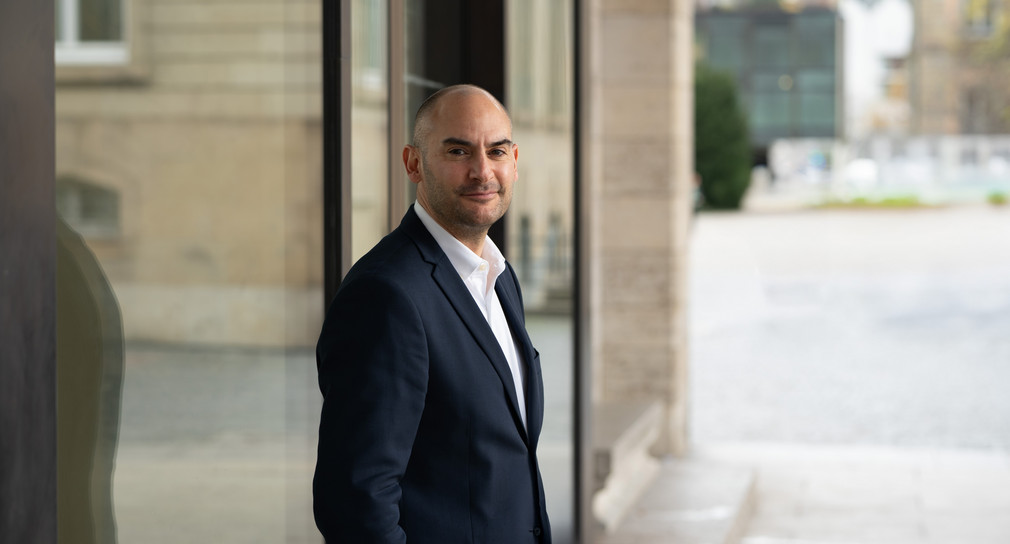
Rede von Dr. Danyal Bayaz, Finanzminister von Baden-Württemberg, beim Neujahrsempfang der Amerikanischen Handelskammer in Deutschland, Regionalverband Baden-Württemberg.
Speech by Dr. Danyal Bayaz, Minister of Finance of Baden-Württemberg, at the New Year's Reception of the American Chamber of Commerce in Germany, Regional Chapter Baden-Württemberg.
Dear American friends, Ladies and Gentlemen,
German Sociologist Armin Nassehi recently reflected on the meaning of trust. His text ended with this statement: "Ich glaube an das Widersprüchliche."„I believe in contradictions." Well, I confess: so do I. If only because believing in contradictions gives me a way out when things refuse to sort themselves neatly. Which brings us to German-American relations!
Our partnership rests on shared values
Our partnership was never free of contradictions. But it always had a strong foundation. The shared conviction that freedom and democracy aren't givens. That they must be defended. And that law comes before arbitrary power.
This foundation was built over generations. Carried by people on both sides of the Atlantic. Carried also by the American Chamber as an important pillar of German-American partnership. We always knew: We share more than divides us. And I'm convinced: This still holds true for both our societies.
People and companies are the real backbone
A few years ago, I travelled to the US with Minister-President Kretschmann. Everywhere we met great interest in cooperation. With regions and cities, with universities, with companies. These partnerships are alive. Firms are closely connected. German companies in the US. American companies here with us. They create jobs. They drive innovation. They connect people. They are the real backbone of our relationship.
The US government sees things differently now
At the same time, we see that the US government now assesses the relationship between our states differently. It treats Europe differently. It defines democracy differently. It defines trade differently. It is working towards a different world order.
We're well advised to take this very seriously! We're well advised to take the new US security strategy very seriously. We continue to argue that close cooperation with Europe is in America's interest. But we cannot rely on this insight prevailing.
We must shape the new world actively
Yes, the old world is over. And it won't come back quickly. Now it's about actively shaping this new world. A world where our interests are protected. Where our values are actually worth something. Where we don't become pawns of others, but are a strong, sovereign actor. Europe must decide: a seat at the table or a place on the menu.
I'm convinced this can be a world where transatlantic partnership gains strength again. But only when we critically examine ourselves – and stare less intently at news tickers about the US government. It's easy to point fingers at others. But you know: When you point at someone, three fingers point back. And on those three fingers stand three tasks: security, competitiveness, Europe.
Security: We must be able to defend ourselves
Europe has lived under the American security umbrella for decades – and still does. I'm certain that military cooperation continues to work well. From Patch Barracks in Stuttgart, US European Command is coordinated – the military headquarters for all of Europe. A few miles away sits Africa Command. Stuttgart is thus the strategic center of American forces for two continents. Around 25,000 Americans belong to this garrison. They live with us, they are part of our region. And I say clearly: We want this to remain so. But even then, we must invest massively in our defense in Germany and Europe. We must be able to defend ourselves so we that don't have to.
Defense spending is an economic opportunity
At the same time I see these investments as an economic opportunity. Baden-Württemberg is excellently positioned for this. Diehl Defence, Hensoldt, Rheinmetall – these companies are growing and hiring. It's about future technologies: sensors, cybersecurity, autonomous systems, artificial intelligence. These are dual-use technologies. What emerges in defense research today can conquer civilian markets tomorrow. The Internet arose from military research. GPS navigation, too. That's why I'm convinced: If we put a substantial part of defense spending into research and development, we're investing in security and in innovation. In new companies. In tomorrow's jobs.
Competitiveness: We need appetite for the new
This brings me to the second major task: We must strengthen our competitiveness.
The German economy is stagnant. The auto industry – Baden-Württemberg's backbone – is under enormous pressure. Our carmakers can still be leaders. But they won't be as dominant anymore. We won't sell as many cars in the world.
Baden-Württemberg nevertheless has everything to remain successful. Tinkerers, inventors, entrepreneurs – that's in this state's DNA. And this DNA always includes: appetite for the new. That made us strong – and we need it again. Carl Benz invented the automobile here. Gottlieb Daimler the combustion engine. Robert Bosch the spark plug. Today it's other technologies: Artificial intelligence. Quantum computing. Biotechnology.
We have excellent conditions for innovation
Cyber Valley in Tübingen is Europe's largest AI research consortium. In Heilbronn, one of Europe's largest AI ecosystems is emerging. The BioPharma Cluster between Ulm and Lake Constance is an international leader. We have excellent universities. Brilliant researchers. From research, start-ups grow. And start-ups become hidden champions in the best case.
Private capital must work for innovation
But: too many good ideas fail for lack of capital, while enormous private wealth in Europe sits unused. In Germany alone, total household financial assets exceed 9 trillion euros. Around 3 trillion of that sits in cash and low-interest accounts. This capital is losing real value. Instead, it could work for innovation and growth. That's why we must create a culture of productive investing. Private pension provision can lead to a rethink here. And we finally need a functioning capital markets union to mobilize European capital for European innovation.
Less perfectionism, more pragmatism
Yet as good as the conditions are through strong research: Unfortunately, we stand in our own way. German perfection made us strong. Today it paralyzes us. While we plan, regulate, review and approve, others act. That's why we need more than cutting red tape. We need a real cultural shift. Less perfectionism, more pragmatism. Fast, good solutions instead of slow, perfect plans. More trust instead of advance approval marathons.
When Putin attacked Ukraine and we no longer wanted to depend on Russian gas, LNG terminals were built in record time. Suddenly it worked. Because we had to. Now we must too! And then we must endure when something doesn't run perfectly. And learn from it!
Make electricity prices the engine of electrification
We must also learn when it comes to decarbonization. The expansion of renewables is a success story. Electrification makes us more independent from fossil fuels. From imports worth billions. But electrification needs affordable power: We must make electricity prices the engine of electrification. This means we should lower electricity tax – for households and all companies. And above all, we must consistently expand renewable energy and grids simultaneously. The faster and more simultaneously we do this, the faster prices fall.
Europe: Together we have the weight
The third task: We need a strong Europe. Europe has 450 million inhabitants. Excellent research. Innovative companies. Attractive living conditions. The world's largest single market, which we must develop and complete. Germany alone doesn't have the weight to negotiate with the US or China as equals. But Europe together does.
Digital sovereignty means mastering key technologies
This question also touches our digital sovereignty. We cannot allow our critical infrastructure, our data, our AI systems to depend completely on non-European providers. Digital sovereignty means: We must master key technological competencies ourselves. Cloud infrastructure. Semiconductors. AI models. Only then can we negotiate as equals. It speaks to the EU's ability to act that the Mercosur free trade agreement is hopefully now coming. But when the EU blocks itself in other areas, we need enhanced cooperation among states that want to move forward. Including Britain.
Your commitment is the foundation
Social ties between Germany and the US remain strong. Economic and scientific cooperation is alive. At the same time, we must now strengthen our security, competitiveness and technological sovereignty. Then we can appear as partners, not as supplicants. And the American Chamber and its members are indispensable as bridge-builders in this. Your commitment to a common future is the foundation of transatlantic relations. We continue to count on you!
Thank you very much.